Radius of Gyration [1]
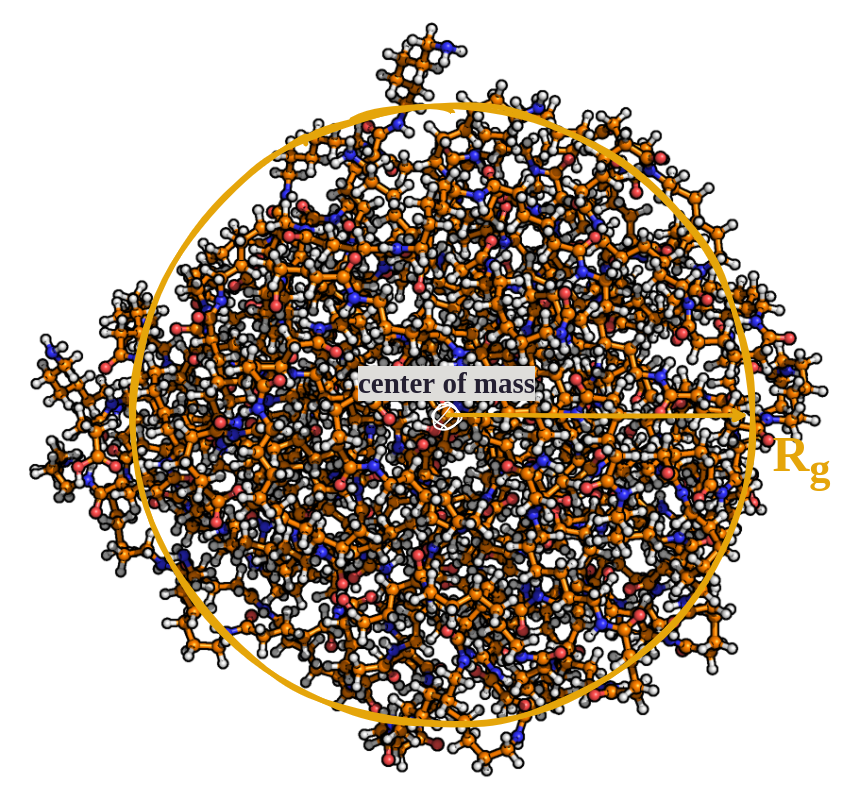
The radius of gyration \(R_g\) quantifies the spatial extent of a structure around its center of mass. MakroLyzer reports a single value per frame for the full graph.
Definition
The squared radius of gyration is defined as
where \(N\) is the number of atoms in the graph, \(\vec{r}_i\) is the position vector of atom \(i\), and \(\vec{r}_{\mathrm{com}}\) is the center of mass position vector of the graph.
Additionally, the radius of gyration tensor G is computed as
with \(\vec{r}_i^{(m)}\) representing the \(m^{\mathrm{th}}\) Cartesian coordinates of the position vector of the \(i^{\mathrm{th}}\) particle, and thus, G describes a symmetric 3 \(\times\) 3 matrix: It is used for the calculation of the anisotropy factor and the asphericity parameter.
Command Line Input
-Rg--radiusOfGyrationExample
MakroLyzer -xyz polymer.xyz -Rg myRgOutput.csv
Output
The output file contains one row per frame with the following columns:
Column |
Description |
|---|---|
Frame |
Frame index in the trajectory |
Rg / Angstrom |
Radius of gyration for the full graph |