Convex Hull Volume and Density [1]
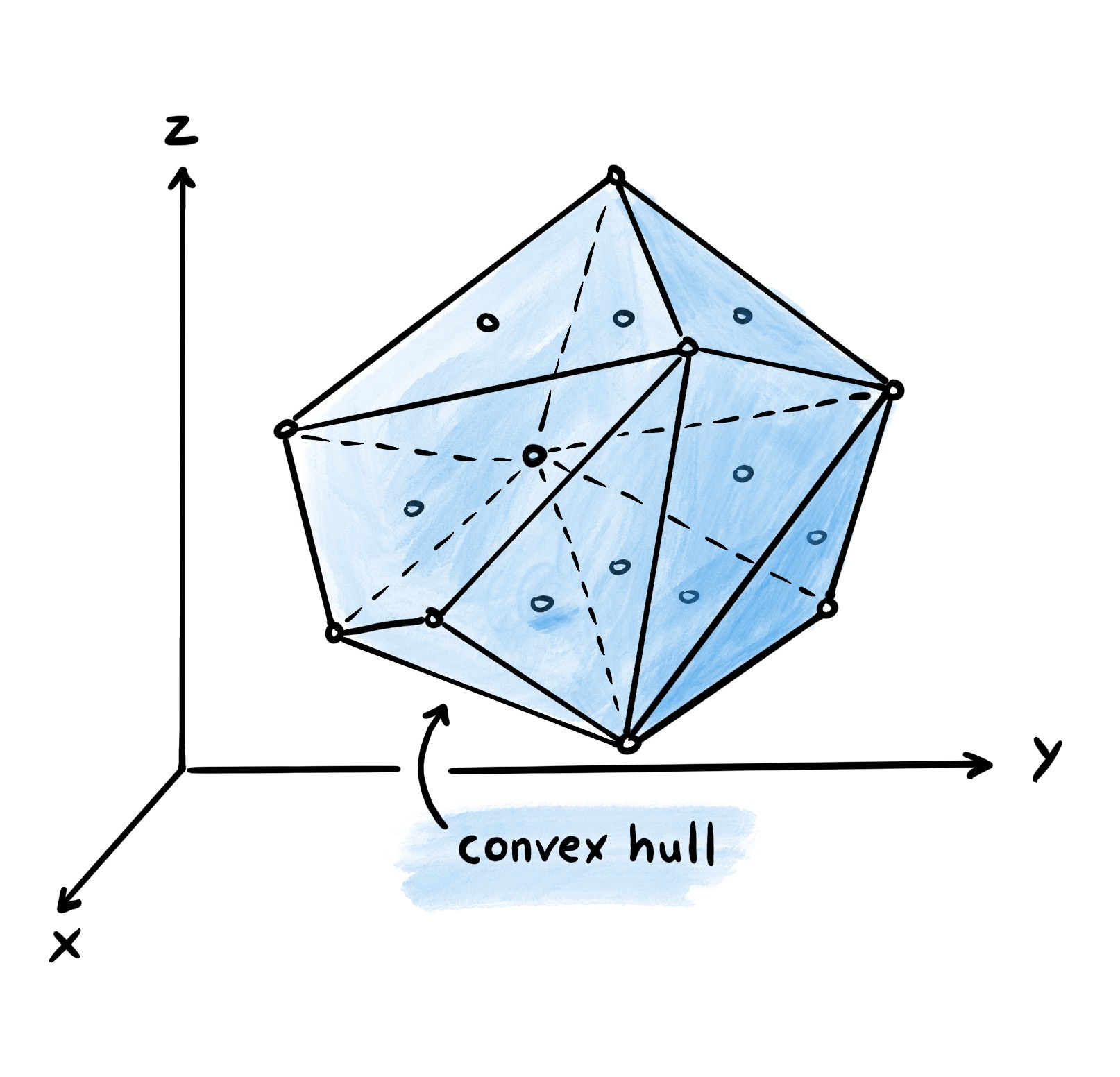
The convex hull of a particle is the smallest convex shape that can enclose all atoms of the particle.
In MakroLyzer, the convex hull is computed using scipy.spatial.ConvexHull [2].
The volume of the convex hull can be used as a measure of the particle’s desnity, which is calculated as the mass of the particle divided by the volume of the convex hull.
Because the convex hull approximates the spatial extent of a particle, it can be used to determine whether other particles penetrate the selected particle. For example, in a solvated polymer, this makes it possible to count how many solvent molecules have their center of mass within the polymer’s convex hull.
Command line
-ConvHullVol--convexHullVolume-ConvHullSol PARTICLE_SEL SOLVENT_SEL--convexHullSolvent PARTICLE_SEL SOLVENT_SEL--hb-between.-ConvHullSol-file--convexHullSolvent-fileExample
MakroLyzer -xyz polymer.xyz -ConvHullVol
MakroLyzer -xyz solvated_polymer.xyz -ConvHullSol CHON H2O
Output
Each row starts with the frame index followed by the volume of the convex hull, the mass of the particle and the density (mass/volume) in CSV format. For solvent counting, each row starts with the frame index followed by the particle selection, solvent selection, convex hull volume and the number of solvent molecules inside the convex hull.